
Kawerau marae and tikanga encompass the ancestral meeting grounds and cultural protocols of the local Māori community, primarily affiliated with Ngāti Tūwharetoa ki Kawerau. These sacred spaces serve as the heart of social, political, and spiritual life, governed by customs (tikanga) that dictate respectful conduct, welcoming ceremonies (pōwhiri), and community engagement.
For residents, visitors, and business leaders in the Eastern Bay of Plenty, understanding the cultural landscape of Kawerau is not merely a courtesy—it is a prerequisite for meaningful connection. Located beneath the majestic shadow of Pūtauaki (Mt Edgecumbe), Kawerau is a town deeply rooted in Māori history and tradition. The marae here are not just buildings; they are the living repositories of genealogy (whakapapa) and the focal points for community decision-making.
Whether you are attending a hui (meeting), paying respects at a tangihanga (funeral), or looking to establish business relationships in the region, navigating the nuances of Kawerau marae and tikanga is essential. This guide provides an authoritative overview of local protocols, marae affiliations, and the cultural competencies required to thrive in this vibrant district.
The Marae of Kawerau: Affiliations and History
To understand the marae of Kawerau, one must first understand the mana whenua (people of the land). The Kawerau district falls primarily within the rohe (territory) of Ngāti Tūwharetoa ki Kawerau. While distinct from the Tūwharetoa people of Lake Taupō, they share common ancestry. The marae in and around this district are the bastions of their identity.
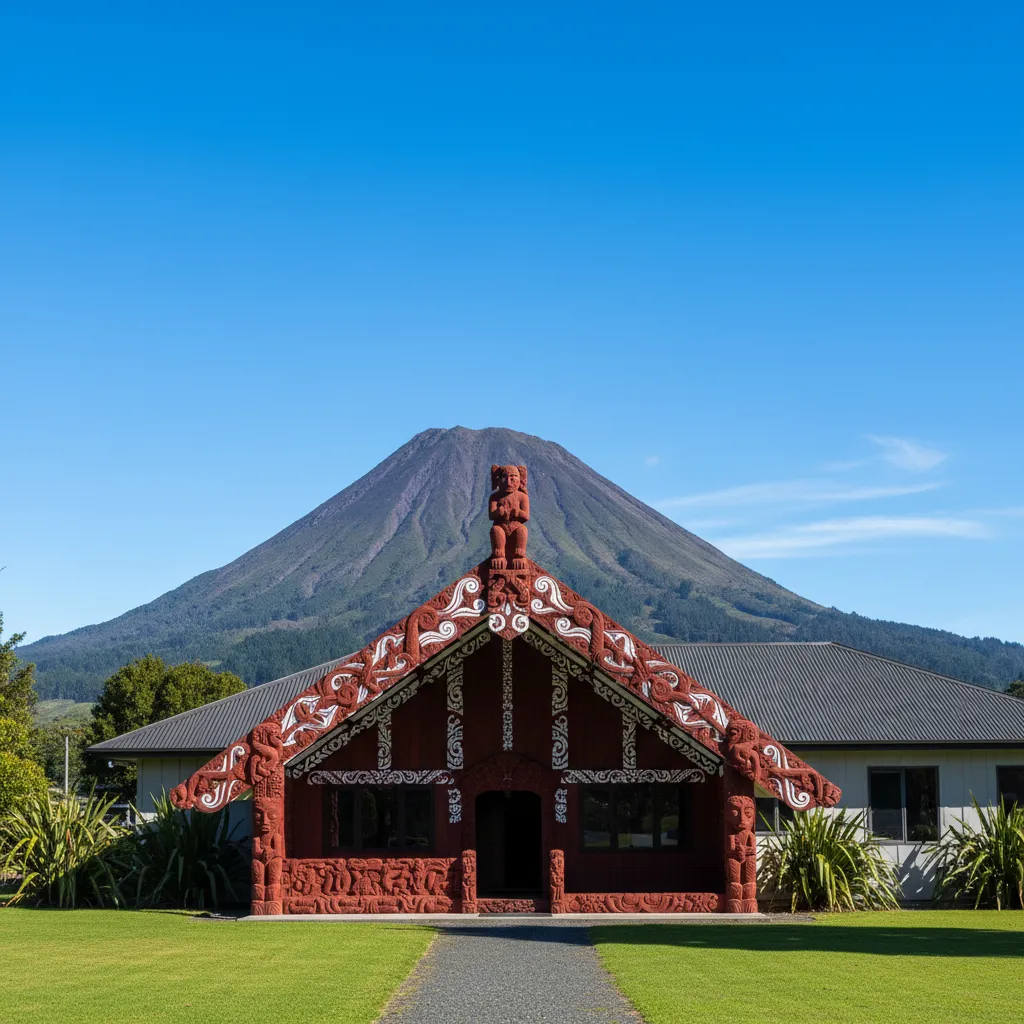
Rautahi Marae: The Community Hub
Rautahi Marae holds a unique and central position within the township of Kawerau. Unlike many rural marae that belong to a specific whānau (family) or hapū (sub-tribe), Rautahi was established to serve the diverse Māori workforce that migrated to Kawerau during the establishment of the Tasman Pulp and Paper Mill in the 1950s.
Key Characteristics of Rautahi Marae:
- Affiliation: While it serves the wider community (Mataawaka), it operates under the mana of Ngāti Tūwharetoa ki Kawerau.
- Location: Centrally located on Onslow Street, making it the primary venue for civic events, school visits, and community hui.
- Significance: The name “Rautahi” implies gathering or bringing together many into one (Squeezing the many leaves into one basket), reflecting its pan-tribal origins while maintaining local authority.
Surrounding Ancestral Marae
While Rautahi is the urban focal point, several ancestral marae surround the immediate Kawerau boundary, holding deep historical significance for the local hapū:
- Hahuru Marae (Onepu): Located just outside Kawerau, this is a principal marae for Ngāti Tūwharetoa ki Kawerau. It is the site of significant tribal decision-making and houses the wharenui (meeting house) Tūwharetoa.
- Tobish Marae (Waitahanui): Situated near the Tarawera River, this marae connects deeply to the river’s history and the spiritual sustenance it provided to the ancestors.
Understanding the Pōwhiri: A Step-by-Step Guide
The pōwhiri is a ritual of encounter. It is the process by which the host people (tangata whenua) determine the intentions of the visitors (manuhiri) and eventually welcome them, lifting the state of tapu (sacred restriction) to reach a state of noa (neutrality/safety). In Kawerau, as in the rest of New Zealand, the pōwhiri follows a structured format, though local nuances exist.

1. The Wero (The Challenge)
For high-ranking dignitaries or special events, a warrior may perform a wero. He will lay a taki (dart/token) on the ground. If the visitors pick it up, they come in peace. In most general business or community contexts in Kawerau, this step is reserved for very formal occasions.
2. The Karanga (The Call)
This is the first voice heard. An elder woman (Kaikaranga) from the tangata whenua calls to the visitors. This high-pitched call weaves a spiritual rope between the hosts, the visitors, and the ancestors. A woman from the visiting group must reply. Tip: If your group does not have a Kaikaranga, you must arrange this with the marae beforehand.
3. Haka Pōwhiri (Ritual of Welcome)
As visitors move slowly onto the marae ātea (courtyard) typically pausing to remember the dead, the hosts may perform a haka pōwhiri—a chant and dance of welcome. This signals that the visitors are now safely under the protection of the hosts.
4. Whaikōrero (Formal Speeches)
Once seated (usually men in the front row, women behind, though protocols vary), the speeches begin. In Kawerau (Tūwharetoa/Mataatua protocol), the speaking order is usually Pāeke, meaning all local speakers speak first, followed by all visiting speakers. This allows the hosts to lay down the kaupapa (topic) clearly.
5. Waiata (Song)
Every speech must be supported by a waiata (song). This signifies that the group supports the words of their speaker. If the song is weak or cut short, it reflects poorly on the mana of the speaker.
6. Koha (Gift)
The last speaker for the visitors will lay down a koha (usually a monetary donation in an envelope) on the ground. This is a contribution to the costs of hosting. It is picked up by a local male, acknowledging the receipt.
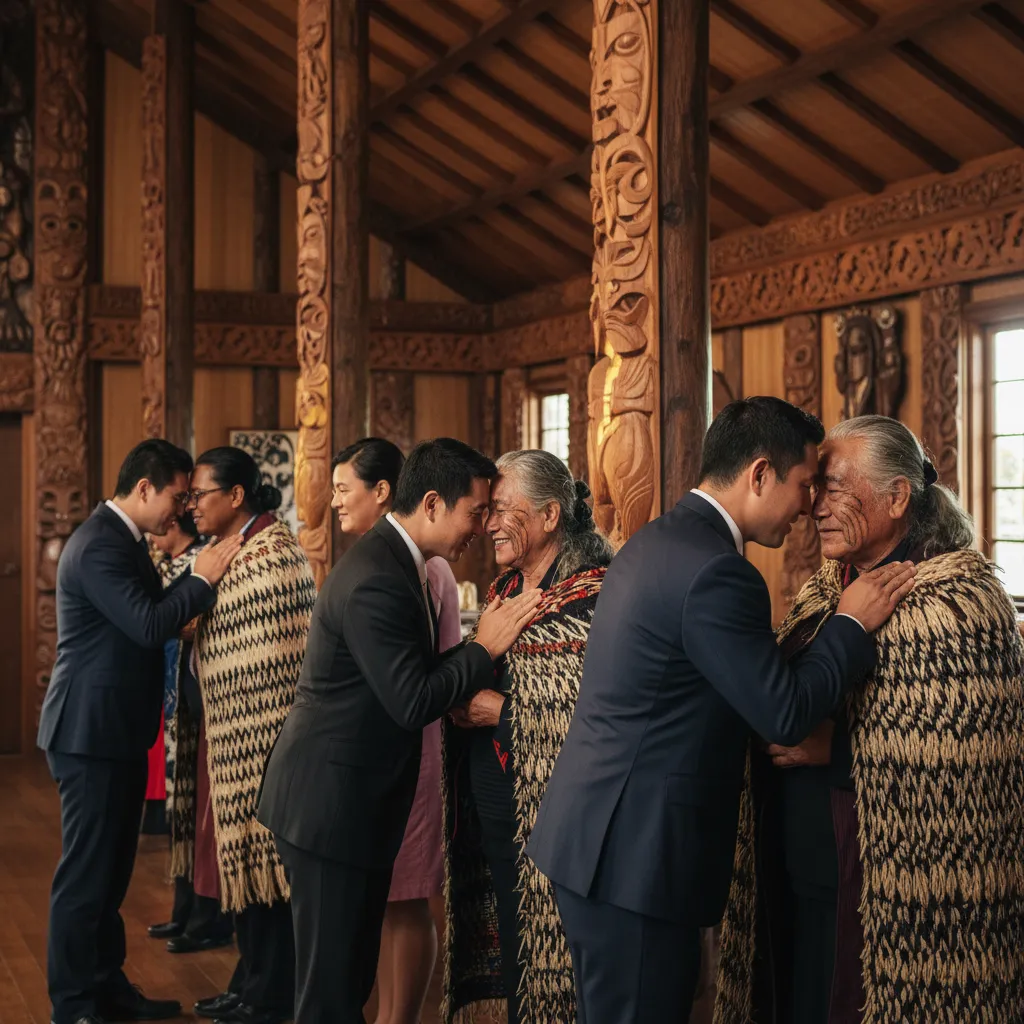
7. Hongi and Harirū
Visitors file past the hosts to shake hands (harirū) and press noses (hongi). The hongi represents the sharing of the breath of life (te hā), stemming from the creation story of Tāne Mahuta. At this moment, the two groups become one.
Essential Tikanga: Do’s and Don’ts for Visitors
Tikanga translates to “the right way of doing things.” When visiting a marae in Kawerau, adhering to these rules shows respect and cultural intelligence.
What is the Dress Code for a Marae?
Dress formally and modestly. For men, this typically means trousers and a collared shirt (jacket and tie for formal occasions). For women, a knee-length or longer skirt or dress is preferred (black is standard for tangihanga). Avoid sunglasses, hats, and revealing clothing while on the marae ātea or inside the wharenui.
Key Protocols to Remember
- Remove Shoes: Always take your shoes off before entering the Wharenui (meeting house).
- Do Not Walk in Front of Speakers: If you must move during speeches, walk around the back of the group, never between the speaker and the listeners.
- No Food or Drink: Food (kai) is noa (common) and destroys tapu (sacredness). Therefore, no food is brought into the meeting house or onto the marae ātea during the formal welcome.
- Photos: Always ask permission before taking photos. It is generally forbidden to take photos during the formal karanga or whaikōrero, and strictly forbidden inside the meeting house without explicit permission.
The Role of Marae in the Kawerau Community
In Kawerau, the marae is far more than a ceremonial center; it is a critical infrastructure for social cohesion and regional resilience. Understanding this role helps new residents and investors appreciate the depth of the community fabric.
Civil Defense and Resilience
During natural disasters or emergencies, marae often transform into Civil Defense hubs. They have the facilities (large kitchens, sleeping areas, ablutions) to house and feed hundreds of people. In a region geologically active like the Bay of Plenty, the marae network is a vital safety net.
Health and Social Services
Many health initiatives, from vaccination drives to youth counseling, are delivered on or through the marae. The holistic Māori model of health, Te Whare Tapa Whā (spiritual, physical, mental, and family health), is naturally practiced in these environments.
Education and Wānanga
Rautahi and Hahuru marae are centers of learning. They host wānanga (educational forums) on weaving, language (Te Reo Māori), and carving. For the Kawerau community, the marae is the university of their heritage.
Cultural Competency for Local Businesses
For the “Kawerau Regional Growth & Lifestyle Hub,” integrating cultural competency into business strategy is a competitive advantage. The Māori economy is a significant force in the Bay of Plenty, and local Iwi are key stakeholders in land development, geothermal energy, and forestry. This includes understanding the local environment, which changes seasonally. For those planning a longer stay, knowing the Best Time to Visit Kawerau: A Seasonal Guide is useful. Furthermore, as the region develops infrastructure, understanding the Industrial Training Programs available helps align with local workforce development. For those considering moving here long-term, information on the Relocation & Digital Nomad Lifestyle is essential.

Why Cultural Intelligence Matters in Kawerau
Businesses that ignore tikanga risk alienating a large portion of their customer base and workforce. Conversely, those who embrace it foster loyalty and open doors to partnership opportunities with Iwi organizations.
Actionable Steps for Businesses
- Pronunciation: Make a genuine effort to pronounce Māori names and place names correctly. “Kawerau” (Ka-we-rau), “Pūtauaki” (Poo-tau-a-ki). Correct pronunciation is a sign of respect.
- Kanohi ki te Kanohi (Face to Face): Māori business is relational, not transactional. Important discussions should happen face-to-face, ideally over food, rather than via email.
- Understand Kaitiakitanga: This concept refers to guardianship of the environment. If your business impacts the land or water (especially the Tarawera River), you must engage with Mana Whenua early to discuss sustainability from a Kaitiakitanga perspective.
- Observe Manaakitanga: This is the value of hospitality and uplifting others. In business, this means looking after your staff and clients genuinely. A business known for poor manaakitanga will struggle to retain local staff.
By respecting the marae and tikanga of Kawerau, you are not just following rules; you are participating in a living culture that has sustained this region for centuries. Whether you are a visitor passing through or a business putting down roots, the spirit of manaakitanga awaits those who approach with an open heart and a respectful mind. Kawerau Essential Services & Amenities are available for residents, while those looking for Winter Wellness Activities should check local listings. Don’t forget to locate facilities using the Kawerau Public Toilets & Showers Map when travelling.
People Also Ask (PAA)
What is the main marae in Kawerau?
The main community marae located within the Kawerau township is Rautahi Marae on Onslow Street. While it is a pan-tribal marae established for the community and mill workers, it operates under the mana of Ngāti Tūwharetoa ki Kawerau.
Do I need to be invited to visit a marae in Kawerau?
generally, yes. You should not wander onto a marae without a reason or an invitation. However, marae are often open for specific community events, church services, or educational visits. If you wish to visit, it is best to contact the marae committee or a local cultural advisor to arrange a proper welcome.
What should I bring as a koha?
A koha is a donation to help with the running costs of the marae (electricity, food, maintenance). Today, this is usually a monetary donation placed in an envelope. The amount is discretionary but should reflect the size of your group and the mana of the occasion.
Can women speak on the marae in Kawerau?
Under the tikanga of Ngāti Tūwharetoa and most Bay of Plenty tribes, formal speaking on the marae ātea (courtyard) during a pōwhiri is reserved for men. However, women play the most vital role of the Karanga (call) which begins the ceremony, and they are permitted to speak in other contexts inside the meeting house depending on the specific occasion.
What happens if I make a mistake during the pōwhiri?
Mistakes happen, and hosts are generally forgiving of those who are learning. If you breach protocol (e.g., walking in the wrong spot), you may be gently guided by a host. The most important thing is your intent—if you are respectful and humble, minor errors are easily overlooked.
How do I contact Ngāti Tūwharetoa ki Kawerau?
You can contact the Tangata Whenua through the Ngāti Tūwharetoa (Bay of Plenty) Settlement Trust or by reaching out to the administration of Rautahi Marae. For business consultations regarding land or resources, contacting the Trust directly is the appropriate first step.