
The cost of living in Kawerau is significantly lower than in Auckland, primarily driven by housing costs that are approximately 65% to 75% cheaper on average. While grocery and utility prices remain relatively comparable due to national pricing structures, residents in Kawerau enjoy substantial savings on mortgage interest, local council rates, and daily commuting expenses compared to Auckland counterparts.
The Housing Divide: Renting and Buying
When analyzing the cost of living Kawerau vs Auckland, housing is the single most influential factor. The disparity between New Zealand’s largest metropolis and the Bay of Plenty’s industrial heartland is stark, offering a completely different financial trajectory for families and first-home buyers.
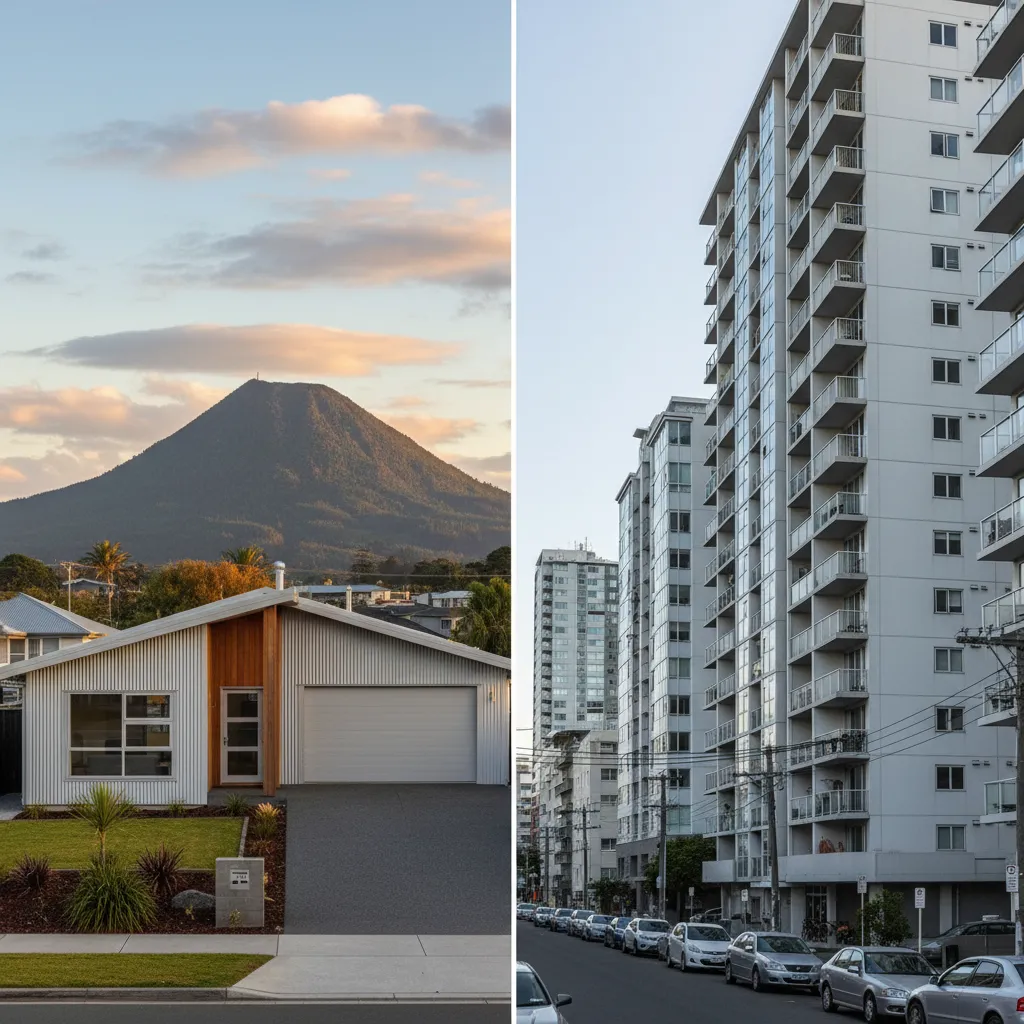
Property Purchase Prices
Auckland’s property market has long been characterized by high entry barriers. As of recent market data, the median house price in the Auckland region often hovers near or above the $1,000,000 mark. This requires a substantial deposit—often $200,000 for a standard 20% equity stake—and servicing a massive mortgage.
In contrast, Kawerau presents one of the most accessible entry points in the North Island. Median house prices here generally sit between $380,000 and $480,000. For a buyer, this means a mortgage that is less than half the size of an Auckland equivalent. The interest savings alone over a 30-year term can amount to hundreds of thousands of dollars, freeing up capital for investments, travel, or retirement savings.
Rental Market Dynamics
The rental market mirrors the sales market. In Auckland, finding a standalone three-bedroom home for under $650 per week is increasingly difficult, with many desirable suburbs commanding upwards of $800 per week. This creates a high “burn rate” for non-homeowners, making it difficult to save for a deposit.
Kawerau offers a reprieve. While rents have risen in line with national trends, a comfortable family home can often be secured for between $400 and $500 per week. This weekly difference of $200-$300 translates to an annual saving of approximately $10,000 to $15,000 in post-tax income, purely on accommodation costs.
Council Rates and Utilities Breakdown
Once you have secured a roof over your head, the ongoing costs of keeping that home running come into play. Understanding the nuances of local government charges and utility infrastructure is vital for a true cost of living comparison.
Council Rates: Whakatāne District vs. Auckland Council
Council rates are calculated based on capital value (CV), but the “rate in the dollar” varies significantly between regions. Auckland benefits from a massive ratepayer base, which allows for some economies of scale, yet the high property values mean the actual dollar amount paid is high.
In Kawerau, rates are generally lower in total dollar terms compared to Auckland suburbs, though they may appear higher relative to the property’s value. However, water billing is a distinct difference. Auckland households pay a separate volumetric charge for water and wastewater (via Watercare). In many parts of the Bay of Plenty, including Kawerau, water costs are often included in the annual rates or charged at different tariffs, often resulting in a lower overall annual spend for water services.

Power and Connectivity
Kawerau is unique in its proximity to major energy generation, specifically geothermal and hydroelectric sources. While retail electricity prices in New Zealand are largely determined by national retailers (Gentailers) and line charges, the reliability of power in Kawerau is generally excellent due to the infrastructure supporting the local industrial mills.
Broadband internet costs are identical across both locations due to the national rollout of Ultra-Fast Broadband (UFB). You will pay the same $85-$100 per month for fibre in Kawerau as you would in Ponsonby, ensuring no disadvantage for digital connectivity.
Transport, Fuel, and Grocery Comparison
Daily variable costs are where the “hidden” expenses of Auckland living often accumulate. While a loaf of bread might cost the same, the cost to acquire it—in terms of fuel and time—differs greatly.
The Commute Tax
Auckland is infamous for traffic congestion. The average Auckland commuter might spend 45 to 90 minutes in traffic daily. This incurs high fuel costs (stop-start driving consumes more petrol) and significant vehicle wear and tear. Furthermore, Auckland has a Regional Fuel Tax (though policy changes can affect this) that has historically made petrol more expensive at the pump compared to the regions.
Kawerau is a compact town. The “commute” is measured in minutes, not hours. Most residents can drive from one side of town to the other in under 5 minutes. If you work locally, your fuel bill could drop by 70%. Even if commuting to Whakatāne or Rotorua (approx. 30-45 mins), the drive is open-road highway cruising, which is far more fuel-efficient than city gridlock.

Grocery Pricing and Availability
New Zealand operates under a supermarket duopoly (Woolworths NZ and Foodstuffs). Consequently, shelf prices for dry goods are relatively consistent nationwide. A block of cheese or a can of beans costs roughly the same in Kawerau’s New World as it does in an Auckland Pak’nSave.
However, Kawerau residents have the advantage of the Bay of Plenty’s “food basket” status. Roadside stalls, local orchards, and farmers’ markets in the wider Whakatāne district often provide seasonal produce (kiwifruit, avocados, citrus) at prices significantly lower than Auckland supermarkets. This farm-to-table access can reduce the fresh food portion of your grocery bill by 10-15% if you shop seasonally and locally.
The Remote Work Arbitrage: Savings Potential
The rise of remote work has created a financial arbitrage opportunity: earning an Auckland salary while paying Kawerau living costs. This is the “Goldilocks” scenario for many professionals relocating to the regions.
Calculating the Disposable Income Shift
Let’s look at a hypothetical scenario for a household with a combined income of $150,000.
- In Auckland: After taxes, mortgage payments on a $900k home, higher transport costs, and city-based entertainment, disposable income is often squeezed. Discretionary savings might average $500/month.
- In Kawerau: Retaining that $150,000 income but servicing a $400k mortgage changes the equation. Mortgage payments drop by roughly $600-$800 per week. Transport costs drop. Even with a slight increase in travel budget to visit the city, the household could potentially save $2,500+ per month.
This difference allows for aggressive retirement investing, faster mortgage payoff (becoming mortgage-free in 10 years instead of 30), or a higher standard of living.

Lifestyle Factors and Intangible Costs
Financials are only part of the cost of living Kawerau vs Auckland equation. There are intangible costs and benefits to consider.
Access to Amenities vs. Access to Nature
Auckland charges a premium because it offers premium amenities: international concerts, diverse high-end dining, major sporting events, and specialized medical care. If your lifestyle relies on eating out three times a week at different ethnic restaurants, Kawerau will feel limiting. You pay for the privilege of choice in Auckland.
Conversely, Kawerau offers free access to world-class nature. Tarawera Falls, lakes for fishing, and bush walks are on your doorstep. In Auckland, accessing similar nature usually requires a long drive and often parking fees. In Kawerau, the lifestyle is “rich” in outdoor experiences that cost nothing.
Frequently Asked Questions
Is it cheaper to buy groceries in Kawerau or Auckland?
Staple grocery items cost roughly the same due to national pricing by major supermarket chains. However, Kawerau residents often save money by purchasing fresh produce from local Bay of Plenty orchards and roadside stalls, which are cheaper than Auckland supermarkets.
How much can I save on rent moving from Auckland to Kawerau?
On average, you can expect to save between $200 and $350 per week on rent. Auckland three-bedroom homes often rent for $650-$800+, whereas similar properties in Kawerau typically range from $400 to $500 per week.
Are utility bills higher in Kawerau?
Electricity rates are generally comparable, but heating costs may differ. Kawerau homes are often older and may require more heating in winter, though many are now insulated. Water costs are often lower or included in rates, unlike Auckland’s separate volumetric water billing.
Does Kawerau have good internet for remote work?
Yes. Kawerau has full access to Fibre (UFB) broadband, offering the same gigabit speeds available in Auckland CBD. This makes it an ideal location for remote workers looking to lower their overheads without sacrificing connectivity.
What is the average house price difference?
The difference is substantial. As of 2024, Auckland’s median price hovers around $1 million, while Kawerau’s median is typically between $380,000 and $480,000, making Kawerau less than half the price of Auckland.
Is healthcare more expensive in the regions?
Public healthcare is free across New Zealand. However, access to specialists may require travel to Whakatāne, Tauranga, or Hamilton, incurring travel costs. GP visits in Kawerau are often subsidized or cheaper than high-rent Auckland clinics.