Accessing the Tarawera Falls walking track requires a recreational access permit because the route travels through a private working forest. Permits cost NZ$10 per vehicle and must be purchased in advance either online via the Māori Investments Limited website or in person at the Kawerau i-SITE Visitor Information Centre.
Deep within the Bay of Plenty region, hidden behind the industrial pine forests of Kawerau, lies one of New Zealand’s most spectacular natural phenomena: Tarawera Falls. Unlike traditional waterfalls that cascade over a lip, the Tarawera River pours directly out of fissures in a massive rhyolite lava cliff face, creating a thunderous and visually arresting display.
However, reaching this geological marvel is not as simple as driving to a public car park. Because the access road traverses private forestry land, securing a Tarawera Falls walk permit is a mandatory step for every visitor. This guide provides authoritative instructions on navigating the permit system, driving the forestry roads safely, and maximizing your experience on the track.
How to Get a Forestry Permit for the Falls
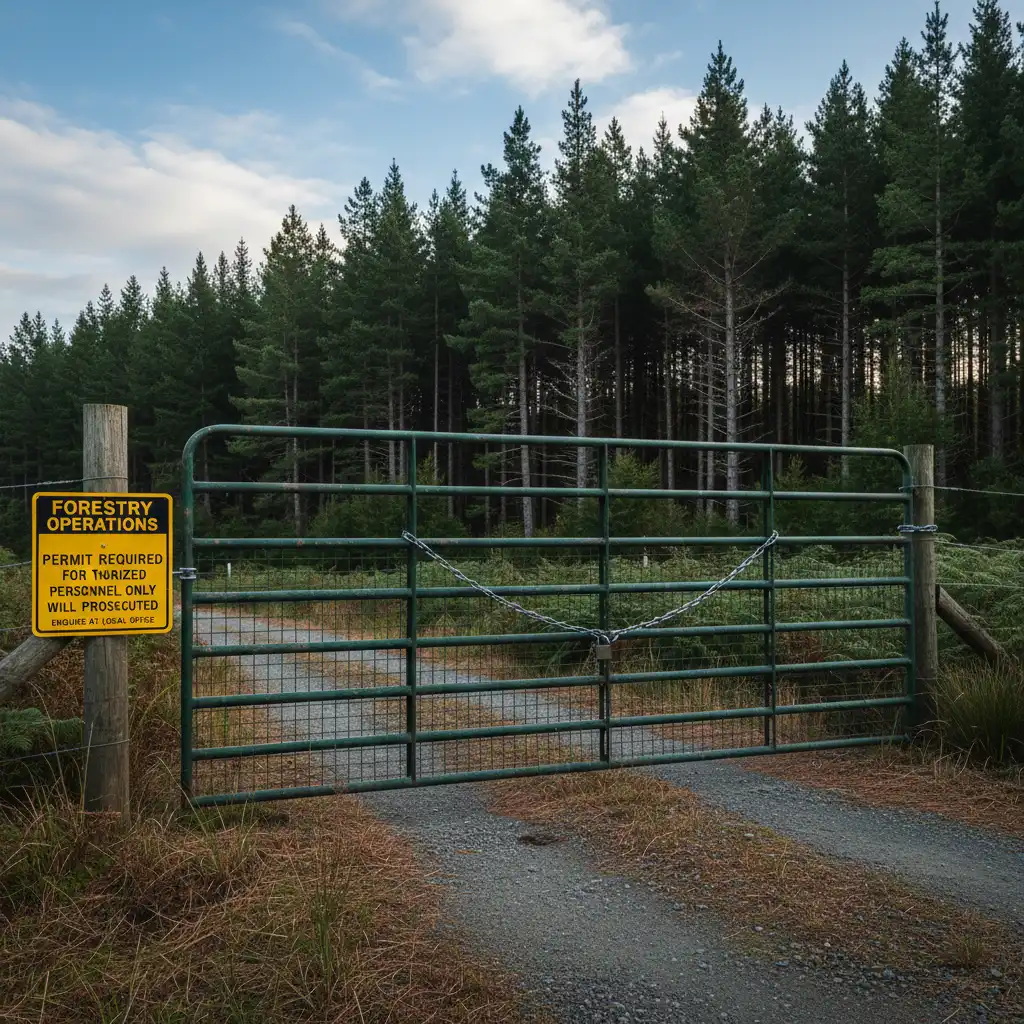
The most critical aspect of planning your trip to Tarawera Falls is understanding that the access road, Waterfall Road, is not a public highway. It is a private logging road owned and managed by Māori Investments Limited. Security gates control access to the forest, and unauthorized vehicles are subject to trespassing laws.
The permit system is strictly enforced to ensure visitor safety within an active logging environment and to maintain the security of the forest assets. Here is the step-by-step process to secure your access.
Online Permit Purchasing
The most convenient method for obtaining a permit is through the official online portal. This is highly recommended if you are planning your trip during weekends or public holidays when physical offices may have varying hours.
- Website: Visit the Māori Investments Limited official website.
- Cost: The fee is currently $10.00 per vehicle (subject to change).
- Process: You will need to provide your vehicle registration number, driver details, and the date of intended entry.
- Receipt: Upon payment, you will receive a digital permit/code. It is crucial to screenshot this or print it out, as mobile cell reception is non-existent once you enter the forest.
In-Person Purchasing at Kawerau i-SITE
If you prefer to pay in cash or need assistance with directions, you can purchase a permit at the Kawerau i-SITE Visitor Information Centre located on Plunket Street in Kawerau.
The staff at the i-SITE are local experts and can provide up-to-date information on road grading status, potential logging closures, or weather warnings. If you buy in person, you will be given a physical pass to display on your dashboard and the access code for the gate.
Gate Access and Hours
The forest access is generally open during daylight hours. The permit grants you access through the automated gate system. You will usually be provided with an access code to punch into the keypad at the gate. Note: The forest is often closed during periods of extreme fire danger (usually late summer) or during intensive harvesting operations. Always check the current status before driving to Kawerau.
Driving Directions and Road Conditions
Once you have your Tarawera Falls walk permit sorted, the drive itself requires specific attention. The journey from the town of Kawerau to the falls car park takes approximately 20 to 30 minutes, depending on road conditions.
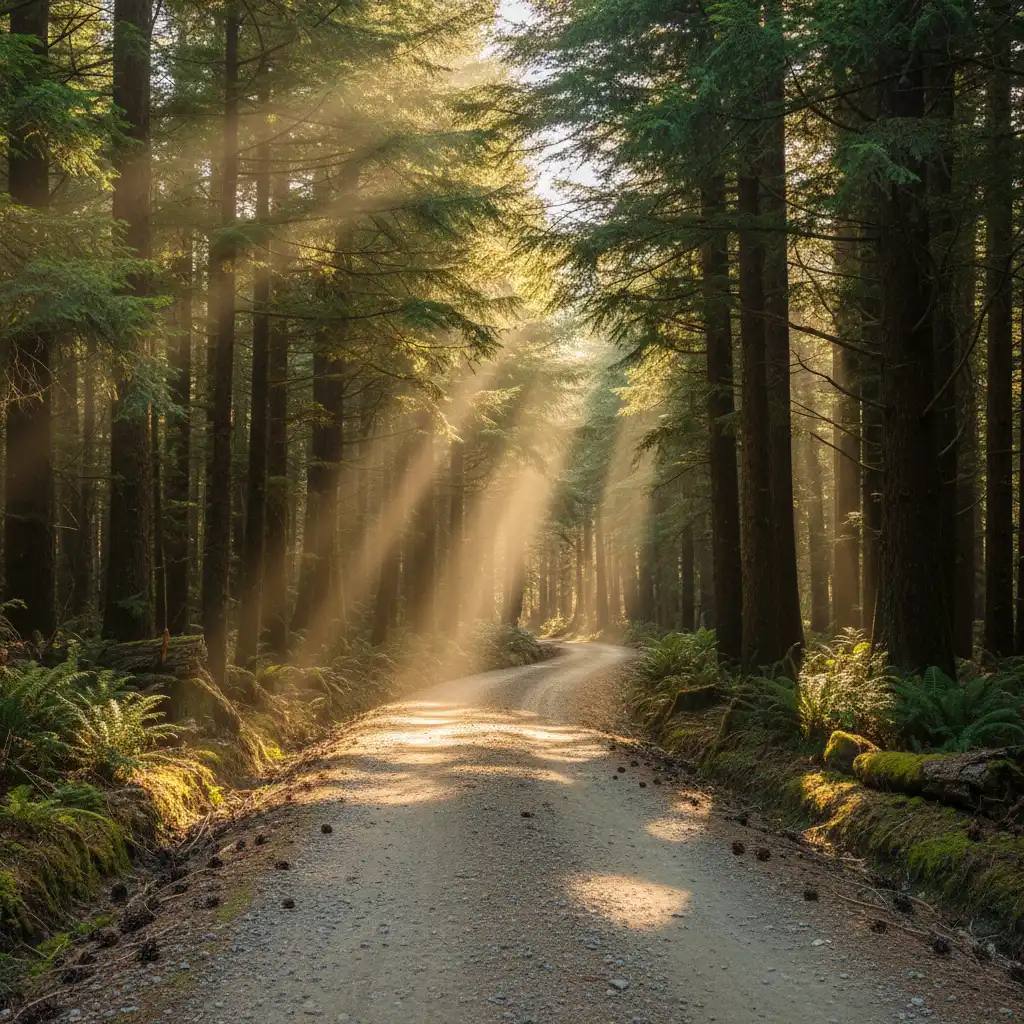
Navigating Waterfall Road
The road is unsealed gravel. While it is generally well-maintained and suitable for standard 2WD vehicles, conditions can deteriorate rapidly after heavy rain. Drivers should expect:
- Corrugations: The road can be “washboarded,” requiring slow speeds to maintain traction and comfort.
- Dust: In summer, visibility can be reduced by dust clouds from other vehicles. Keep a safe following distance.
- Potholes: Watch for deep potholes that can damage low-clearance vehicles.
Sharing the Road with Logging Trucks
This is an operational forest. You must expect to encounter heavy machinery and fully laden logging trucks. These trucks have the right of way at all times. If you see a truck approaching, slow down, pull as far to the left as safely possible, and stop if necessary to let them pass. Their stopping distance is significantly longer than yours, and they cannot maneuver easily.
Track Difficulty and Accessibility Notes
The walk from the car park to the falls viewing area is one of the most rewarding short walks in the North Island. It offers a high reward-to-effort ratio, making it popular for families and casual hikers.
Track Statistics
- Distance: Approximately 1.4 km (one way) to the falls viewing area.
- Time: 20–40 minutes (one way).
- Grade: Easy / Grade 2.
Terrain Description
The path follows the Tarawera River upstream. The track is well-formed, wide in most places, and relatively flat, with only gentle undulations. The surface is a mixture of compacted soil and forest floor litter (pine needles and leaves). While it is an easy walk, it is not paved.
Is the Track Wheelchair or Stroller Friendly?
While the track is flat, it is not classified as wheelchair accessible due to roots, potential mud, and uneven surfaces. All-terrain strollers (buggies with large pneumatic tires) can usually manage the track with some effort, but standard city strollers with small plastic wheels will struggle.
The Advanced Loop: Falls to Tarawera Outlet
For those seeking a longer adventure, the track continues past the falls up to the Tarawera Outlet (where the river flows out of Lake Tarawera). This section is significantly steeper and requires a moderate level of fitness. It takes approximately 2 hours to reach the outlet from the falls. If you choose this option, ensure you have adequate water and sturdy footwear.
The Unique Geology of the Falls
To truly appreciate the view, it helps to understand what you are looking at. Tarawera Falls is not fed by a surface river flowing over a cliff edge. Instead, the water travels underground from Lake Tarawera through a series of subterranean lava tubes and fissures.
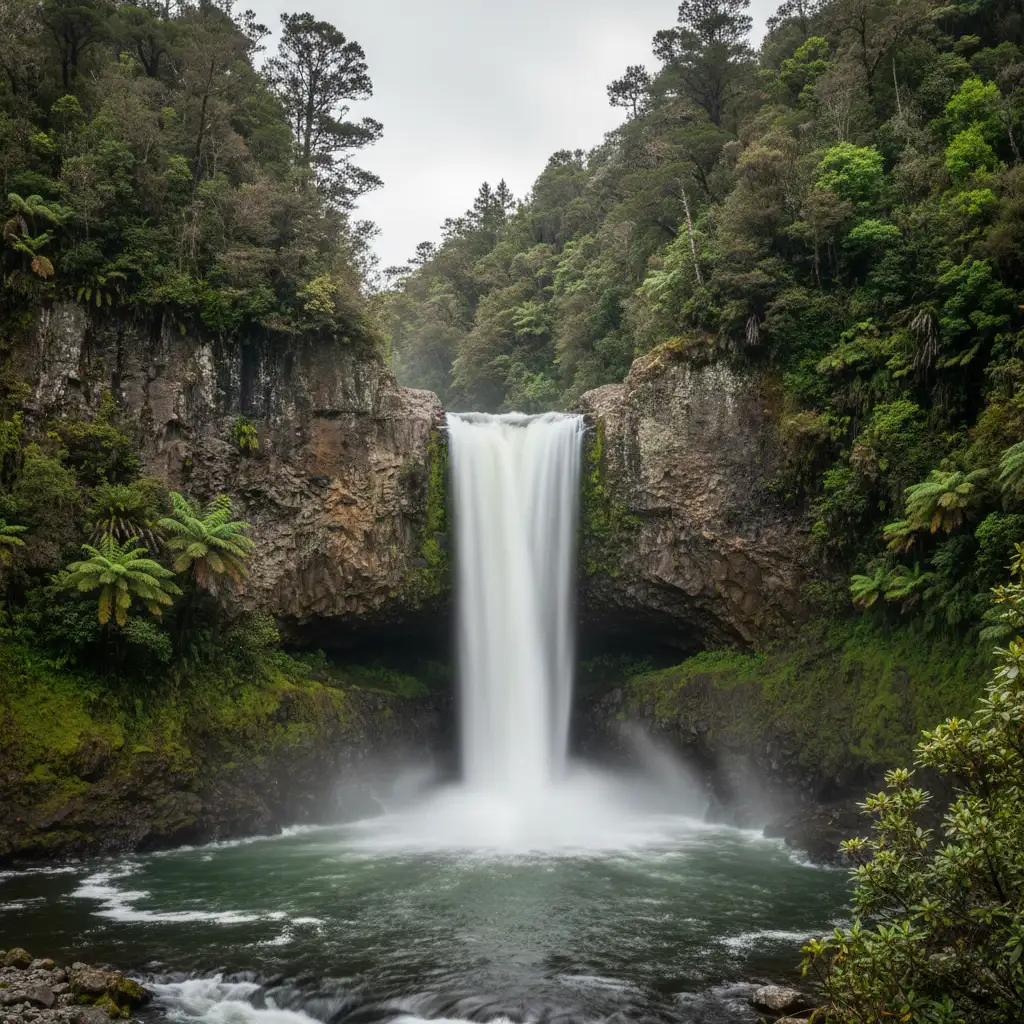
Approximately 11,000 years ago, lava flows from Mt Tarawera blocked the river’s original valley. The water eventually found its way through the porous rock, emerging abruptly from the center of the cliff face. This geological quirk is why the waterfall appears to shoot straight out of the rock wall, approximately 35 meters up, before crashing down another 30 meters to the pool below.
Best Photo Spots Along the Waterfall
Tarawera Falls is a photographer’s dream due to the contrast between the white water, the dark volcanic rock, and the vibrant green native bush. Here are the prime locations to set up your tripod.
1. The Main Viewing Platform
At the end of the easy track, there is a designated viewing area with a wooden barrier. This offers the classic, unobstructed frontal view of the falls. It is the best spot for capturing the full scale of the cliff face.
Pro Tip: Use a wide-angle lens (16mm–24mm full-frame equivalent) to capture the height of the cliff without cutting off the river at the bottom.
2. The River Boulders (Downstream)
About 5–10 minutes before you reach the falls, there are several access points to the river’s edge. Large volcanic boulders sit in the stream here. These make excellent foreground subjects. You can frame the rushing blue water leading the eye toward the distant falls (though the falls may be partially obscured by trees).
3. The Base of the Falls
It is possible to scramble carefully over the rocks to get closer to the base pool. The mist here can be intense, so bring a lens cloth. This angle allows for powerful shots looking straight up at the water emerging from the rock.
Lighting Advice: The falls are located in a deep valley. The best light is often on overcast days, which acts as a giant softbox, preventing harsh shadows and blown-out highlights on the white water. If shooting on a sunny day, early morning or late afternoon is essential to avoid high-contrast lighting.
Swimming Safety at the Falls Base
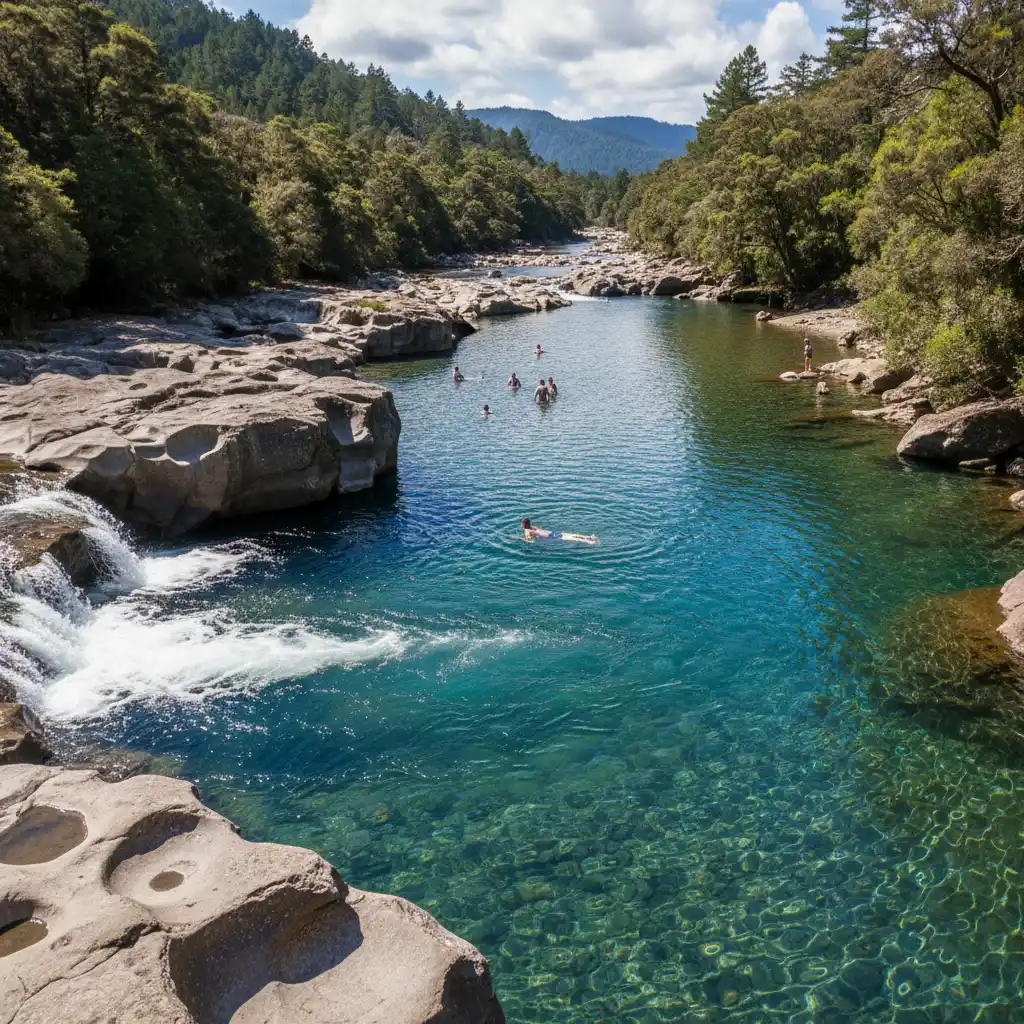
The crystal-clear, azure water of the Tarawera River is incredibly inviting, especially after the dusty drive and warm walk. However, swimming here requires extreme caution.
Water Temperature and Currents
The water comes from deep underground and is extremely cold year-round. Cold water shock can occur even in summer. Furthermore, the current is deceptive. While the pools may look calm, the volume of water moving through the river is massive.
The Danger Zone
Do not swim directly under the waterfall. The force of the falling water is immense and can pin a swimmer underwater. Additionally, rocks and debris can fall from the cliff face without warning. There have been accidents and fatalities in this area in the past.
Safe Swimming Areas
If you wish to take a dip, the safer spots are the calm eddies located further downstream from the main falls, near the bridge or the picnic areas. Always check the depth before jumping, as submerged logs and rocks are common. Children should be supervised closely at all times near the water’s edge.
Frequently Asked Questions
Can I buy a Tarawera Falls permit on the weekend?
Yes, you can buy permits online 24/7 via the Māori Investments Limited website. If you need to buy one in person, the Kawerau i-SITE is generally open on weekends, but you should check their specific operating hours before traveling.
Is the road to Tarawera Falls suitable for a campervan?
Small to medium campervans can usually negotiate the gravel road without issues, provided they are driven slowly. Large motorhomes may struggle with corrugations and overhanging branches. Always secure all loose items inside the vehicle before entering the forestry road.
Are dogs allowed on the Tarawera Falls track?
Generally, dogs are allowed but must be kept on a lead at all times. This is a kiwi zone, and forestry operations may also be using poison for pest control. However, access rules can change, so it is vital to check the specific conditions on your permit or ask at the i-SITE.
Is there cell phone reception at Tarawera Falls?
No. There is virtually no cell phone coverage once you leave the township of Kawerau and enter the forest. You should download offline maps and save your permit to your phone (or print it) before you leave town.
How long is the drive from Rotorua to Tarawera Falls?
The drive from Rotorua to the town of Kawerau takes about 45 minutes to an hour. From Kawerau, it is another 20–30 minutes on the gravel road to the falls car park. Allow at least 1.5 hours total travel time one way.
Are there toilets at the Tarawera Falls car park?
Yes, there are basic long-drop (composting) toilets located at the car park at the start of the track. There are no facilities along the track or at the falls viewing platform, so plan accordingly.